Charles Edward Stuart, also known as Bonnie Prince Charlie, was Prince of Wales in the legitimist House of Stuart succession to the British and Irish thrones and senior figure in his father's court and government in exile. He was born in Rome and lived in French and Italian exile until the War of the Austrian Succession, when he travelled to Scotland, instigated, and led the Jacobite Rising of 1745.
In contrast to other, more traditional depictions, the Prince and his cause are depicted unflatteringly in the Outlander series, whose main protagonists, Jamie and Claire Fraser, repeatedly attempt to covertly sabotage the rising from within.
Personal History
Prince Charles Edward Stuart, the son of Prince James Francis Edward Stuart and Princess Maria Klementyna Sobieska, was born in the Palazzo Muti, Rome, Italy, where his father was given a residence and government in exile by Pope Clement XI. He spent almost all his childhood in Rome and Bologna, being brought up in a loving but argumentative Catholic family. Their household servants included, as an honorary groom of the bedchamber, future outlawed Jesuit missionary to Clan Fraser of Lovat, Jacobite Army military chaplain, and Roman Catholic martyr Fr. Alexander Cameron (1701-1746).
As the senior legitimate heirs under dynastic law of the House of Stuart, though deprived of the throne since the 1688 Glorious Revolution, his family lived with a sense of pride and staunchly believed in the Divine Right of Kings, but also remained carefully informed and felt both grief and concern over the continuing religious persecution, disenfranchisement, and denial of all civil rights to their fellow Catholics in Great Britain, Ireland, and British North America. (See Forty Martyrs of England and Wales, Irish Catholic Martyrs, Catholic Church in Scotland, Mass rock, Hedge school, Priest hole, and Priest hunter).
Regaining the throne, reviving the Declaration of Indulgence to grant universal religious toleration and thus end the anti-Catholic religious persecution that began under King Henry VIII and ended only with the Catholic Emancipation Act in 1829 remained a constant topic of conversation. This promised political reform, as well as opposition to the many other religious, political, and linguistic policies of the Whig single party state that dominated His Majesty's Government from 1714-1783, gave Jacobitism widespread appeal and created a very large coalition of the disaffected of multiple political ideologies, religious beliefs, ethnic, and linguistic backgrounds.
During the War of the Polish Succession in 1734, Charles Edward observed the French and Spanish forces during the siege of Gaeta, his first exposure to the art of war. In December 1743, Charles's father named him Prince Regent, granting him wide authority to act on behalf of the court in exile. His father managed to obtain the renewed support of King Louis XV during the War of the Austrian Succession in 1744; and Charles Edward traveled to France with the sole purpose of commanding a French invasion and regime change war in the British Isles.[2]
When the French Royal Navy fleet was wrecked by storms on the verge of sailing, Charles resolved to proceed to the west coast of Scotland accompanied by only the Seven Men of Moidart. Allegedly inspired by hearing the Scottish Gaelic poetry of Alasdair MacMhaighstir Alasdair read aloud to him in English translation at the Château de Saint Germain-en-Laye, the Prince arranging to be smuggled by a French corsair ship and landed first at Eriskay and then at Loch nan Uamh. After convincing a highly reluctant Donald Cameron of Lochiel to raise his clan, the Prince's Standard was first blessed by an equally reluctant Bishop Hugh MacDonald and then raised at Glenfinnan, marking the beginning of the Jacobite rising of 1745. The Jacobite forces under Charles initially achieved several victories in the field, including the Battle of Prestonpans in September 1745 and the Battle of Falkirk Muir in January 1746. However, after the Jacobite Army leaders disastrously overruled him and retreated from Derby towards Scotland even as King George II was packing his things and preparing to flee back to his ancestral Electorate in Germany, the Jacobites were defeated by Prince William, Duke of Cumberland at Culloden. Even so, Prince Charles managed to escape the no quarter given afterwards by the Duke's order to the Jacobite prisoners and the wounded.
He successfully evaded capture afterwards and was eventually evacuated to France from the site now marked by the Prince's Cairn, despite scorched earth and total war being unleashed against the whole civilian population of the Highlands around him and a £30,0000 bounty promised for his apprehension. According to recent historian and Celticist John Lorne Campbell, this British war crimes during the post-Culloden "Year of the Pillaging", were committed so indiscriminately against Whigs, Jacobites, Protestants, and Catholics alike and to such an extreme degree that they violently enraged the whole population of the Gàidhealtachd and the Doric-speaking northeast. This caused not only Jacobite bards in Scottish Gaelic like John Roy Stewart and Alasdair Mac Mhaighstir Alasdair to demand a speedy revenge against His Majesty's Government, but even formerly pro-Hanoverian bards like Duncan Ban MacIntyre and Rob Donn issued multiple calls in verse for their clans to cast off their traditional allegiance and join the next of the Jacobite risings. The defeat of the rising at Culloden and the continued exile of the Stuart King in exile were also lamented in the iconic Aisling song Mo Ghile Mear by Irish language poet Seán Clárach Mac Domhnaill.
The Prince's escape to France, however, was soon followed by the Hanoverian espionage recruitment and infiltration of the Jacobite movement in exile by a highly placed mole codenamed "Pickle the Spy". The latter's highly damaging reports to his handlers and successful stirring up of distrust and dissension within the movement destroyed the Stuart cause far more effectively than the Battle of Culloden or it's immediate aftermath ever could have dreamed. While there were subsequent attempts, such as a planned French invasion during the later Seven Years War that was scuttled by the Royal Navy victory at the Battle of Quiberon Bay in 1759, Charles was unable after the retreat from Derby in 1746 to ever again come so close to restoring the House of Stuart to the British and Irish thrones.[3]
Charles spent the remainder of his life in exile on the continent, except for one secret visit to London.[4] On his return, Charles lived briefly in France before he was expelled in 1748, under the terms of the Treaty of Aix-la-Chapelle. Charles then returned to Italy, where he divided his remaining life between Florence and Rome. He kept a number of mistresses before marrying Princess Louise of Stolberg-Gedern in 1772. In his later life, Charles's life became increasingly hedonstic, his health declined greatly, and he was said to have become an alcoholic. After his Queen in exile followed the example of his once loyal followers by deserting him for another man, Charles died an isolated and embittered man at Rome in 1788. His lonely death in exile was widely regarded as marking the end of an era and was lamented in a immortal Scottish Gaelic elegy by village schoolmaster and Presbyterian catechist William Ross.
Even so, his military escapades during the 1745-1746 uprising, his escape from Scotland despite a massive manhunt, and the political devolution, minority linguistic rights, and religious toleration reforms the House of Stuart government in exile once promised and fully intended to implement have all led to Prince Charles Edward's remembrance as the leader of an honourable cause that faced a tragic but heroic failure.[5][6] The Prince's life and the once possible prospects of a restored Stuart monarchy, as well as the continued relevance of Jacobitism to ongoing debates related to religious freedom, devolved rather than over-centralized government, and minority language rights have all left an enduring historical fascination that continues to shape his legacy today. [7][8]
Events of the Novels
Dragonfly in Amber
In 1744: Charles leaves his father's court in Rome and goes to France to try to persuade his cousin King Louis XV to back him in a rebellion attempt. He begins an affair with Louise de La Tour de Rohan and gets her pregnant. Charles begins scheming to reclaim the Scottish throne behind the back of his father. He receives an offer of fifty thousand pounds from an English backer, though it is contingent upon his setting foot on English soil.
Charles's friendship with Jamie Fraser deepens and he starts inviting him to taverns in the evenings. Charles continues to be snubbed by Louis, who won't receive him at court, thus ensuring that he cannot mingle in French society and make the connections he needs to fund his plans. Charles secures a loan from a bank to invest in a shipment of high quality port with the Comte St. Germain. Philip of Spain refuses to lend any assistance to the Stuarts and Charles's investment in the shipment of port is lost, thanks to Jamie and Murtagh faking smallpox on board the ship.
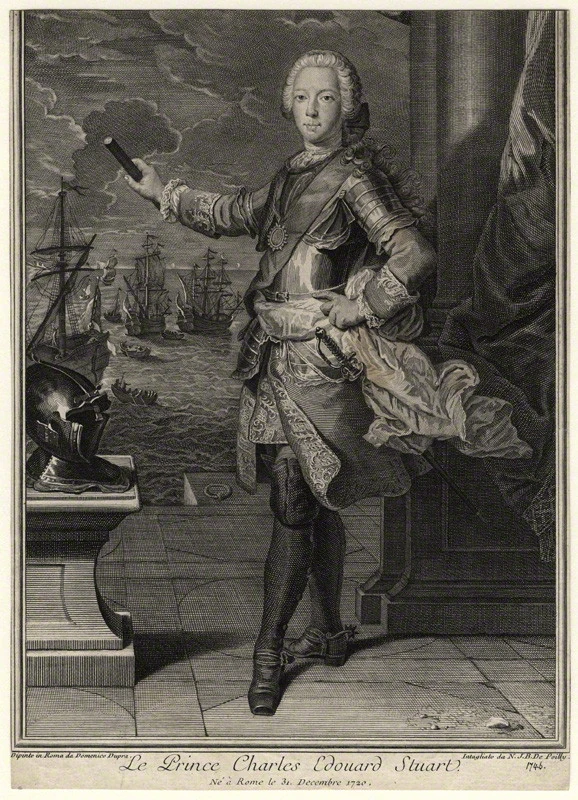

Line engraving of Charles Edward Stuart in 1746
In 1745: Charles begins his campaign to reclaim the throne. He sends out a broadsheet stating his intentions; the document is signed by his supporters, and Jamie discovers – to his horror – that Charles has taken the liberty of signing Jamie's name to it.
Charles's Jacobite army wins its first major engagement at the Battle of Prestonpans with very few casualties. In October, after Prestonpans, Charles leads his army back to Edinburgh. During his time at Edinburgh, Charles engenders some ill will by snubbing most of the Scottish noblemen and instead turning to his old friends from the continent for advice. Charles Stuart's forces attempt to take Stirling Castle from the English by siege. His victory is brief, but inspires him to attempt to march onward into England, despite a lack of support from those living south of Edinburgh. He instructs Jamie to go to Simon Fraser, Lord Lovat and bring the men of Clan Fraser to join his army. Charles also asks Jamie to leave Donas behind for him to ride and Jamie agrees, as he fears Lord Lovat may steal him.
Charles takes his army into England but his chiefs refuse to go further than Derby and he is forced to return northward. When Jamie's men are caught deserting Charles is furious and has them all thrown into the Tolbooth under sentence of death. Dougal MacKenzie arrives to join the Highland army with 250 men and 10,000 pounds in sterling, for which Charles is grateful, as his money is running low.
In 1746: Jamie, Dougal, and Simon Fraser, Master of Lovat call on Charles Stuart at Stirling Castle and plead with him to release the Lallybroch men from prison. In March 1746, the man who had promised Charles Stuart £50,000, the Duke of Sandringham, is killed without having fulfilled his promise. By April, the Highland Army is in retreat and running out of food. Charles Stuart takes command of the army and orders them to take a stand on Culloden Moor.
Personality
Jamie describes him as no great thinker, but charming in person with the ability to persuade people to do things against their better judgment.[9]
Physical Appearance
Sturdy and good looking with loosely curling, thick light brown hair and a fair face.[10] He has soft brown eyes.[11]
Relationships
- Louise de La Tour: In 1744 in Paris, Charles has an affair with Louise, who passes off their child as the offspring of her husband.
- Jamie Fraser: Charles accepts Jamie as a confidante while navigating the political waters of Paris, and later during the Jacobite rebellion in Scotland.
Name
- Charles is from the Germanic name Karl, which was derived from a Germanic word meaning "man". However, an alternative theory states that it is derived from the common Germanic element hari meaning "army, warrior".[12]
- Edward means "rich guard", derived from the Old English elements ead "wealth, fortune" and weard "guard".[13]
- Louis is the French form of Ludovicus, the Latinized form of Ludwig,[14] from the Germanic name Chlodovech, which was composed of the elements hlud "famous" and wig "war, battle".[15]
- John is the English form of Iohannes, the Latin form of the Greek name Ιωαννης (Ioannes), itself derived from the Hebrew name יוֹחָנָן (Yochanan) meaning "Yahweh is gracious".[16]
- Casimir is the English form of the Polish name Kazimierz, which may be derived from the Slavic element kaziti "to destroy" combined with miru "peace, world".[17] The alternative description derives his name from Slavic kazati meaning "to preach".[citation needed]
- Sylvester is a Medieval variant of Silvester,[18] from a Roman name meaning "of the forest" from Latin silva "wood, forest".[19]
- Severino is an Italian, Spanish and Portuguese form of Severinus,[20] a Roman family name which was derived from Severus[21] a Roman family name meaning "stern" in Latin.[22]
- Maria is the Latin form of Greek Μαρια, from Hebrew מִרְיָם (Mary),[23] the meaning is not known for certain, but there are several theories including "sea of bitterness", "rebelliousness", and "wished for child". However it was most likely originally an Egyptian name, perhaps derived in part from mry "beloved" or mr "love".[24]
- Stuart is a variant of Stewart,[25] an occupational name for an administrative official of an estate or steward, from Old English stig "house" and weard "guard".[26]
Trivia
- In real life, Charles did not begin his affair with Louise until 1747.
- Louise and Charles Stuart were first cousins.
- In the novel, Charles was bitten by Louise's temperamental pet monkey that dislikes everyone.
TV Series
English actor Andrew Gower portrays Charles Stuart on the Outlander television adaptation.[27]
Appearances
Gallery


References
- ↑ In the novel, Louise writes to Claire to tell her that her son by Charles is named Henri. In real life, Henri born in August 1745 was a legitimate heir of Louise's husband, and her illegitimate child by Charles, born in 1748, was named Charles and died in infancy.
- ↑ Charles Edward Stuart
- ↑ McLynn, Frank (1988). Charles Edward Stuart: A Tragedy in Many Acts London: Routledge. ISBN 979-8646825446. Page 449.
- ↑ Aronson, Theo (1979). Kings over the water: the saga of the Stuart pretenders, London: Cassell. ISBN 978-0304303243. Page305.
- ↑ McLynn, Frank (1988), Charles Edward Stuart: A Tragedy in Many Acts, London: Routledge. ISBN 979-8646825446. Page 8.
- ↑ Preston, Diana (1995). The Road to Culloden Moor. Bonnie Prince Charlie and the 45' Rebellion, Constable. ISBN 978-0094761704. Pages 13–19.
- ↑ Douglas, Hugh (1975). Charles Edward Stuart, London: Hale. ISBN 978-0709148159. Page x.
- ↑ Preston, Diana (1995). The Road to Culloden Moor. Bonnie Prince Charlie and the 45' Rebellion, Constable. ISBN 978-0094761704. Pages 13–19.
- ↑ Dragonfly in Amber, chapter 22
- ↑ Dragonfly in Amber, chapter 11
- ↑ Dragonfly in Amber, chapter 36
- ↑ Behind the Name: Charles - accessed 09 June 2016
- ↑ Behind the Name: Edward - accessed 09 June 2016
- ↑ Behind the Name: Louis - accessed 09 june 2016
- ↑ Behind the Name: Ludwig - accessed 09 June 2016
- ↑ Behind the Name: John - accessed 09 June 2016
- ↑ Behind the Name: Casimir - accessed 09 June 2016
- ↑ Behind the Name: Sylvester - accessed 09 June 2016
- ↑ Behind the Name: Silvester - accessed 09 June 2016
- ↑ Behind the Name: Severino - accessed 09 June 2016
- ↑ Behind the Name: Severinus - accessed 09 June 2016
- ↑ Behind the Name: Severus - accessed 09 June 2016
- ↑ Behind the Name: Maria - accessed 09 June 2016
- ↑ Behind the Name: Mary - accessed 09 June 2016
- ↑ Behind the Name Surname: Stuart - accessed 09 June 2016
- ↑ Behind the Name Surname: Stewart - accessed 09 June 2016
- ↑ 'Outlander' Season 2: Bonnie Prince Charlie, Fergus & More Roles Cast – June 10, 2015